Wedges are an essential part of any golfer’s bag, especially when it comes to approaching the green. However, understanding the loft of your wedges is crucial for making the right shot selection. A wedge loft chart can help you determine which wedge to use for different distances and shot types.
A wedge loft chart typically displays the loft angles of different wedges, ranging from pitching wedges to gap wedges, sand wedges, and lob wedges. The loft angle refers to the angle of the clubface in relation to the ground, which affects the trajectory and distance of the ball when struck. By referring to a wedge loft chart, you can determine the right club to use based on the distance you need to cover and the type of shot you want to make.
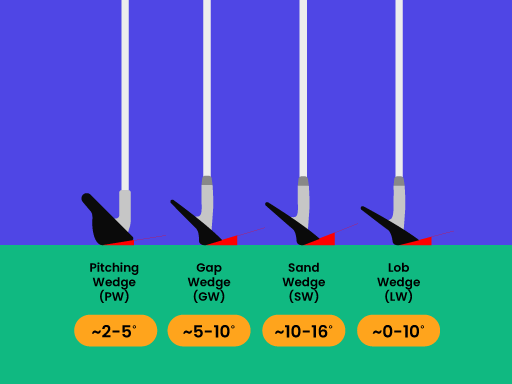
For example, a pitching wedge usually has a loft angle of around 46-48 degrees, making it ideal for shorter approach shots of around 100-130 yards. A gap wedge typically has a loft angle of 50-54 degrees, suitable for distances between 90-110 yards. Sand wedges, with loft angles of 54-58 degrees, are designed for shots out of bunkers or from the rough. Lastly, lob wedges have loft angles of 58-64 degrees, perfect for high, short shots around the green.
When using a wedge loft chart, it’s essential to consider not only the loft angle but also the bounce angle of the wedge. The bounce angle refers to the angle between the leading edge of the clubface and the lowest point of the sole. A higher bounce angle is beneficial for shots from soft turf or sand, while a lower bounce angle works better on firm ground.
By understanding the loft and bounce angles of your wedges and referring to a wedge loft chart, you can improve your shot selection and accuracy on the course. Experiment with different wedges to see which ones work best for your game and practice using them in various situations to become a more versatile and skilled golfer.
In conclusion, a wedge loft chart is a valuable tool for golfers looking to optimize their wedge play. By familiarizing yourself with the loft and bounce angles of different wedges and using a wedge loft chart to guide your shot selection, you can enhance your performance on the course and lower your scores. Remember to practice with your wedges regularly to develop a feel for each club’s capabilities and improve your overall game.